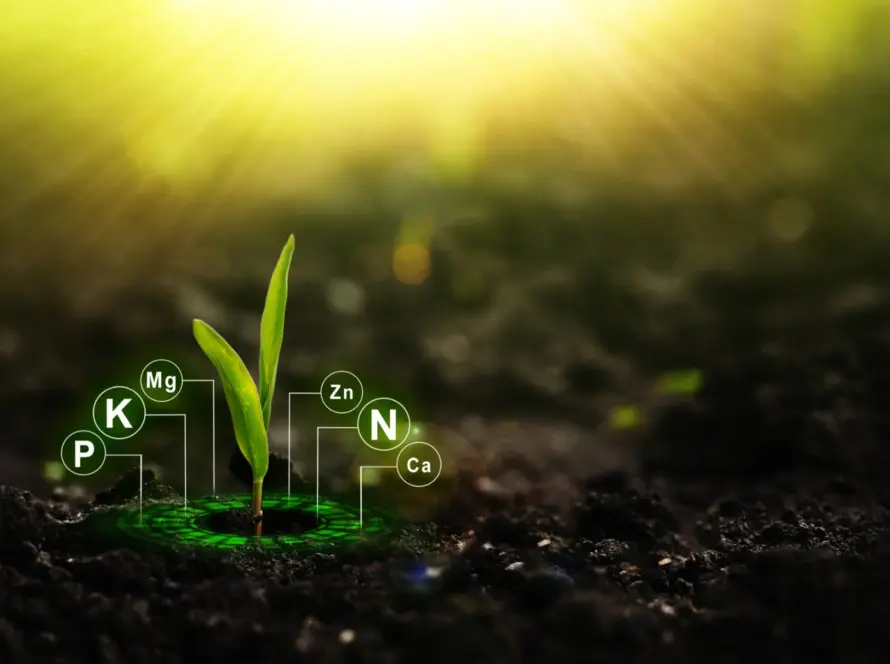
“Why are my plant leaves yellowing even though I fertilize regularly?” This is the question that costs farmers millions of dollars annually. In the world of modern agriculture, a wrong diagnosis means wrong treatment, and wrong treatment means double the loss (cost of fertilizer + loss of crop).
In this specialized guide, we dive deep into “Plant Physiology” to reveal the subtle differences between Starvation (Deficiency) and Overindulgence (Toxicity), and expose the hidden causes of leaf yellowing that have nothing to do with Nitrogen deficiency.
1. The Hidden Battle: Nutrient Deficiency vs. Toxicity
A common mistake is believing that any change in leaf appearance means a “deficiency.” The truth is that Nutrient Toxicity has become more common in 2025 due to the excessive use of concentrated fertilizers.
Visual Diagnostic Guide:
| Comparison Point | Nutrient Deficiency | Nutrient Toxicity |
|---|---|---|
| General Appearance | Pale, Chlorosis (yellowing), general stunting. | Burns, scorched edges, Necrosis (dead spots). |
| Leaf Shape | Leaf often retains its shape but changes color. | Leaf deforms, curls, or takes on a “claw” shape. |
| Speed of Onset | Gradual and slow (plant starves slowly). | Rapid and sudden (chemical shock to the plant). |
| Location (Crucial) | Depends on “Nutrient Mobility” (see next section). | Often appears on tips of older leaves where salts accumulate. |
2. The “Location” Rule: How to Identify the Culprit from the Injury Site?
To understand the language of plants, you must know that nutrients are divided into two types within the plant:
- Mobile Nutrients: (Nitrogen N, Phosphorus P, Potassium K, Magnesium Mg).
- Behavior: When the plant starves, it withdraws these elements from older leaves and sends them to new growing tips to ensure survival.
- Injury Location: Symptoms appear on Lower (Old) Leaves first.
- Immobile Nutrients: (Iron Fe, Calcium Ca, Boron B, Sulfur S).
- Behavior: These elements are “stubborn” and do not move. If they run out in the soil, new growth will find nothing to feed on.
- Injury Location: Symptoms appear on Growing Tips and New Leaves immediately.
Golden Rule: Yellowing at the top = Iron or Sulfur deficiency. Yellowing at the bottom = Nitrogen or Magnesium deficiency.
3. Common Fertilization Mistakes: Why Do Leaves Turn Yellow? (Hidden Causes)
Not every yellowing needs “Urea”! Here are the three mistakes that deceive even experts:
Mistake #1: pH Lockout
You apply fertilizer, but the plant doesn’t eat it. Why? Because the soil pH is unsuitable.
- The Scenario: If pH rises above 7.5, Iron, Manganese, and Zinc turn into insoluble forms (precipitates).
- The Result: The plant screams from hunger (yellowing tips) while its roots swim in a sea of fertilizer!
Mistake #2: Nutrient Antagonism
Nutrients compete to enter the root. An excess of one element may “kick out” another. This is illustrated by Mulder’s Chart.
- Most Common Trap: Excessive Potassium (K) (to size up fruit) immediately blocks the absorption of Magnesium (Mg) and Calcium (Ca).
- The Symptom: Magnesium deficiency appears (interveinal yellowing on old leaves) even though Magnesium is present in the soil.
Mistake #3: The Fake Deficiency
- The Cause: Overwatering or Root Rot.
- The Mechanism: When roots suffocate with water, they lose the ability to breathe and absorb Nitrogen.
- The Deception: The plant shows yellowing that looks exactly like Nitrogen deficiency. If you add fertilizer in this case, you will kill the remaining sick roots!
Frequently Asked Questions (FAQs) – Expert Answers
Q: How do I treat “Fertilizer Burn” if it happens by mistake?
A: The immediate solution is “Flushing.” Irrigate the plant with large amounts of fertilizer-free water (3 times the volume of the pot or area) to dissolve accumulated salts and wash them away from the roots. Stop fertilizing completely for a week until the plant recovers.
Q: What is the difference between Iron Chlorosis and Magnesium Chlorosis?
A: Both cause “Interveinal Chlorosis” where veins remain green and tissue turns yellow. The core difference is the location:
- Iron: Appears on New (Upper) Leaves.
- Magnesium: Appears on Old (Lower) Leaves.
Q: Can “Leaf Analysis” be used instead of guessing?
A: Absolutely, and it is the optimal solution in commercial modern agriculture (2025). Leaf Tissue Analysis gives you the exact number for each element inside the plant, revealing “Hidden Hunger” before visual symptoms even appear.
Conclusion
Correct diagnosis is half the cure. Before opening the next bag of fertilizer, look at the “location of injury” and check your “irrigation system.” Always remember: In modern fertilization, a calculated little is better than a wasted lot.